The History of Akron’s Art and Theater Community
A City That Found Its Voice Between Factory Whistles and Footlights
Before Akron was known for polymers, before it reinvented itself as a modern hub of innovation, before the rubber boom and the factories that shaped its skyline — this city already had something brewing under the surface. Creativity. Expression. A kind of restless spirit that couldn’t be contained by mills or machinery.
If you listen closely enough, you can still hear it: the faint echo of a piano warming up backstage, the hush of an audience right before the lights rise, the brushstroke of a local painter working late in a converted warehouse studio. Akron has always been practical, hardworking, blue-collar to its core — but it has also always been a city that hungers for art, for storytelling, for beauty.
And the history of Akron’s art and theater community isn’t just a timeline. It’s a testament to how creativity grows in the unlikeliest places — even in a city built on rubber, sweat, and steel.
When Art First Took Root: A Creative Spark in an Industrial City
In the late 1800s and early 1900s, Akron was booming with industrial growth, yet something softer began blooming alongside the factories. While workers filled the rubber plants, musicians, painters, and writers found their own corners of the city to gather and create.
One of the earliest beacons was the Akron Art Institute, founded in 1922 inside the basement of the public library. A basement — imagine that. A handful of volunteers, borrowed walls, makeshift classrooms. But it was enough to start something. Enough to give artists a space to show work and for Akron residents to experience culture beyond factory gates.
The theater scene wasn’t far behind. Community groups began forming, staging makeshift productions in borrowed halls and church basements. It wasn’t glamorous, but it was earnest — and Akron audiences embraced it.
The Birth of Akron Institutions That Would Shape the Arts
As Akron grew, so did its creative appetite. By the 1930s and 40s, the city was ready for something bigger, something polished. That’s when the cultural landscape shifted dramatically.
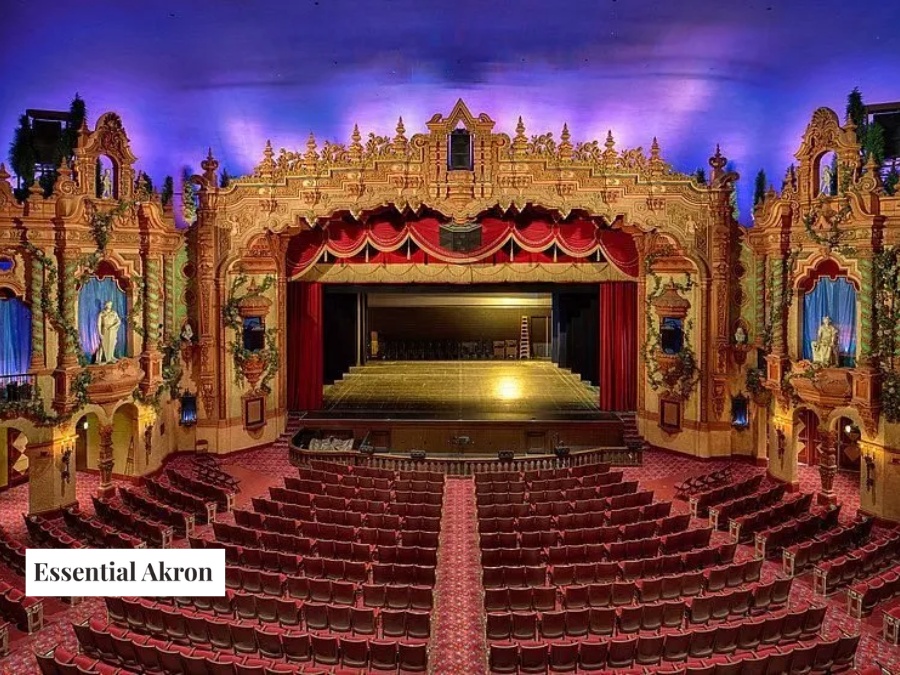
The Akron Civic Theatre — A Jewel in the Rust Belt
When the doors opened in 1929, the Civic Theatre was like stepping into another world. Velvet curtains, Mediterranean architecture, a starry sky ceiling that made audiences feel like they were watching performances outdoors at midnight.
It was Akron’s way of saying:
“We deserve beauty, too.“
The Civic became the beating heart of the city’s artistic identity — hosting vaudeville shows, big band performances, films, stage productions, and visiting stars.
The Akron Art Museum Grows Up
That little basement art institute evolved steadily into what became the Akron Art Museum, officially established in 1950. Over the decades, it collected modern and contemporary works that challenged, inspired, and sometimes puzzled visitors — exactly what art is meant to do.
The museum’s expansion in 2007, with its bold steel-and-glass architecture, stands as one of the city’s proudest cultural landmarks — a symbol of Akron’s artistic ambition.
The Community Behind the Curtain: Theater as Akron’s Living Room
In Akron, theater has always been more than entertainment. It’s community. It’s collaboration. It’s families building sets together, teenagers finding their voices on stage, retirees learning lines with the same passion as young actors dreaming of New York.
Groups like Weathervane Playhouse, founded in 1935, transformed from modest amateur gatherings into a powerhouse of local creativity. Their productions — from comedies to musicals to experimental plays — shaped generations of performers and audience members.
Meanwhile, University of Akron’s theater programs, high school drama departments, multicultural dance groups, and local performance collectives kept the city’s creative energy alive through decades of change.
When the factories slowed in the 1970s and 80s and the city faced economic uncertainty, theater — along with art and music — became both refuge and rebellion. A reminder that even when industry faltered, imagination didn’t.
Art in the Neighborhoods: Creativity Moves Beyond Downtown
As Akron reinvented itself in the modern era, the arts migrated, expanded, and flourished in unexpected places.
Northside District
Old warehouses became studios. Galleries opened beside coffee shops. Musicians filled small stages with new sounds. This neighborhood became the meeting point for young artists, entrepreneurs, and longtime Akron creatives.
Summit Artspace
A former industrial building turned creative incubator where painters, photographers, sculptors, and performers share space, ideas, and energy. Its gallery shows have become pillars of Akron’s modern identity.
Street Art, Murals, and Public Installations
Creativity spilled onto city walls — bold color splashed across brick, stories told through community murals, artists reclaiming forgotten corners with beauty and expression. Akron’s streets slowly transformed into an open-air gallery.Art wasn’t just in institutions anymore.
It was in the neighborhoods, the alleys, the parks, the festivals, the sidewalks.
The Modern Era: A City That Still Believes in Creativity
Today, Akron’s art and theater scene is vibrant in a way that feels both grounded in history and eager for the future.
• The Civic hosts Broadway tours, concerts, comedians, and local productions.
• Weathervane remains a beloved home for community theater.
• The Art Museum pushes boundaries with contemporary exhibitions.
• Lock 3 concerts and public performances bring thousands together every year.
• Local studios and maker spaces give artists room to grow.
• Small theaters and pop-up venues nurture new performers and creators.
Akron isn’t trying to be New York or Chicago or even Cleveland.
It’s proudly itself — a city where creativity grew not from prestige or patronage, but from passion.
Why Akron’s Creative Story Still Matters
Art often thrives in places where people work hard, dream big, and build from the ground up. Akron is that kind of place. Its creative history is proof that beauty can grow beside industry, that imagination can coexist with machinery, and that a community’s voice doesn’t fade when its factories do.
Today, when Akron artists paint murals on old brick buildings or when actors take the Civic stage under that famous starry ceiling, they’re not just performing. They’re continuing a long, resilient tradition — one shaped by workers, dreamers, immigrants, students, families, and everyday Akronites who believed this city deserved color, sound, laughter, reflection, and wonder.
Akron’s art and theater community didn’t just survive its history.
It became part of what makes the city unforgettable.