Summit County Is in the Highest Radon Zone. Akron’s Older Basements Make It Trickier.
From a York, Pennsylvania radon directory founder in another top-tier radon county: what old foundations do with soil gas, and how Akron homeowners can test and hire with confidence.
Quick Answer: The EPA puts Summit County in Radon Zone 1, its highest-risk tier, where average indoor levels are predicted to exceed the 4.0 pCi/L action level. Older homes with stone or block foundations, dirt-floor sections and crawl spaces tend to let more soil gas in, and they often need more than a basic one-pipe system to fix. Ohio offers free test kits through the Department of Health, and anyone you hire to test or mitigate has to hold an Ohio radon license.
I write to you from York County, Pennsylvania, and we have a lot in common with Akron. We’re both Zone 1 counties, and both are old industrial towns full of houses that went up long before anyone had heard of radon. In York, state testing data puts basement averages near 10 pCi/L in some ZIP codes, and roughly a third of homes test above the action level.
My work these days is looking closely at how radon companies handle the houses in my area, and the hard cases are rarely the new ones. They’re the century-old basements, and Akron has plenty of those.
Akron was built fast and early
Much of Akron went up during the rubber boom. Goodyear Heights was laid out starting around 1912 to house workers from the Goodyear plants, and Harvey Firestone built Firestone Park for his own workforce in the same era. Streets of solid, well-built homes spread across the city in those decades.
Those houses have lasted, which says something about the people who built them. But nobody was designing basements to keep soil gas out a hundred years ago. Builders wanted a foundation that held the house up and stayed reasonably dry. Radon wasn’t part of the conversation until the 1980s.
Where soil gas gets into an old basement
Radon comes up out of the ground and moves toward lower air pressure, and a heated house is lower pressure than the soil around it. Warm air rises and leaks out near the roof, which pulls replacement air in at the bottom. That’s the stack effect, and it’s why readings tend to run higher in the colder months.
In a newer house with a poured slab and poured walls, that gas has limited ways in. An older basement usually offers more of them:
- Stone and block walls. Fieldstone walls are full of mortar joints that have had a century to crack. Hollow concrete block can carry soil gas up inside the cores and let it out wherever the block is open or cracked.
- Thin or patched floors. Early basement floors were often thin, poured over whatever was underneath, and patched as the years went on. Some older homes still have a section of bare dirt.
- Crawl space pockets. An addition or a porch built over a crawl space can connect to the main basement and share its air.
- Old openings. Floor drains, sump pits, coal chutes, abandoned pipe runs and utility penetrations all give soil gas a path in.
None of this means your house has a radon problem. It means the foundation won’t tell you, and the county zone won’t either. Only a test will.
Why the fix can be harder in an old house
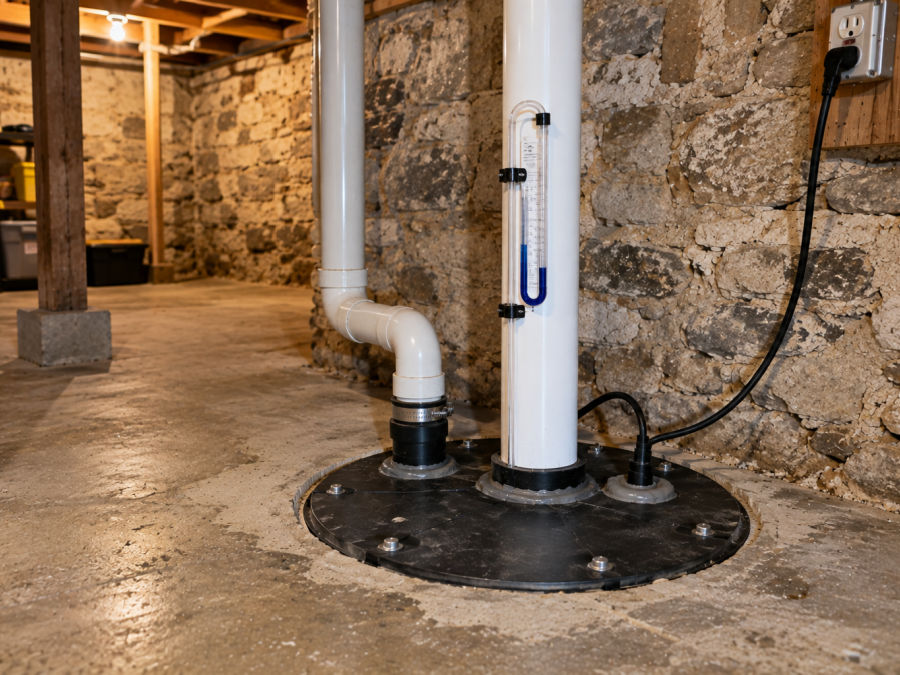
A standard radon system works by pulling air from under the basement slab and venting it above the roof, so the house stops drawing soil gas in. For that to work well, the slab has to hold a vacuum and air has to move freely underneath it.
Older basements complicate both. A cracked, patched floor leaks the suction back into the room. Wet, dense soil under the slab can keep the vacuum from spreading. A dirt-floor section needs a plastic membrane sealed over it, with its own suction point underneath. Block walls sometimes need their own treatment. Getting it right can mean sealing the major openings first, running more than one suction point, or combining approaches.
This is why an in-person inspection matters before anyone quotes you a price. A contractor who quotes an old house over the phone is guessing, and you’ll pay for the guess one way or the other.
Test first, and test the right spot
Ohio’s Department of Health gives away free radon test kits through ohio.radon.com. The program is popular. When the Columbus Dispatch published an investigation into radon last November, Ohioans requested thousands of kits within days, and the state briefly ran out before restocking. January is Ohio Radon Awareness Month, so if kits are out when you look, check back then. Hardware-store kits run about $15 to $50.
Old basements are often divided into several rooms, so placement matters. Put the kit in the lowest level of the house that someone actually uses, away from exterior walls, drafts, the sump and the furnace. Keep windows and doors shut as much as you can during the test.
If you’ve finished a basement room, added a bathroom downstairs or sealed up an old crawl space, test again afterward. Changing how air moves through the bottom of the house can change the reading.
Ohio licenses radon professionals, so check
Ohio handles this better than a lot of states. The Ohio Department of Health licenses radon testers, mitigation specialists and mitigation contractors under state law, and it publishes a map of licensed providers you can search. Pennsylvania works much the same way through our Department of Environmental Protection.
I founded York PA Radon Pros to vet radon mitigation companies in York, PA, because homeowners kept telling me they didn’t know who to trust. The questions I use there work just as well in Summit County, and for an older Akron home, these are the ones I’d ask:
- What’s your Ohio radon license number? Look it up yourself on the state’s licensee map.
- Will you inspect the house in person before you quote? That goes double for any house with a stone foundation or a dirt section.
- How will you handle my foundation specifically? A good contractor can explain how they plan to deal with your walls, floor and crawl space in plain words.
- Does your price include a follow-up test after the system runs? That test is the only proof the job worked.
If a contractor gets defensive about any of those, keep calling around.
An old house can be fixed
Akron’s older homes are worth keeping, and radon is no reason to give up on one. Most can be brought down below the action level. It just takes a contractor who understands old foundations. You can start this week with a free kit.
Tom Bartokowski is the founder of York PA Radon Pros (yorkparadonpros.com), which vets radon mitigation companies in York, PA. He does not perform radon testing or mitigation himself.